

BARGAINING BASICS
Collective bargaining, also known as union contract negotiations, is one of the most basic union processes. It’s important for members to know the basics about it.
While every set of negotiations is different, check out the general information below.
Always feel free to contact your union representative should you have any questions.
Frequently Asked Questions About Bargaining
What is collective bargaining?
Collective bargaining is a legally protected process of negotiations between a union and an employer for a collective agreement.
A collective agreement is another name for your union contract, which sets out the terms and conditions of employment for all unionized employees in a workplace.
How long does the bargaining process take?
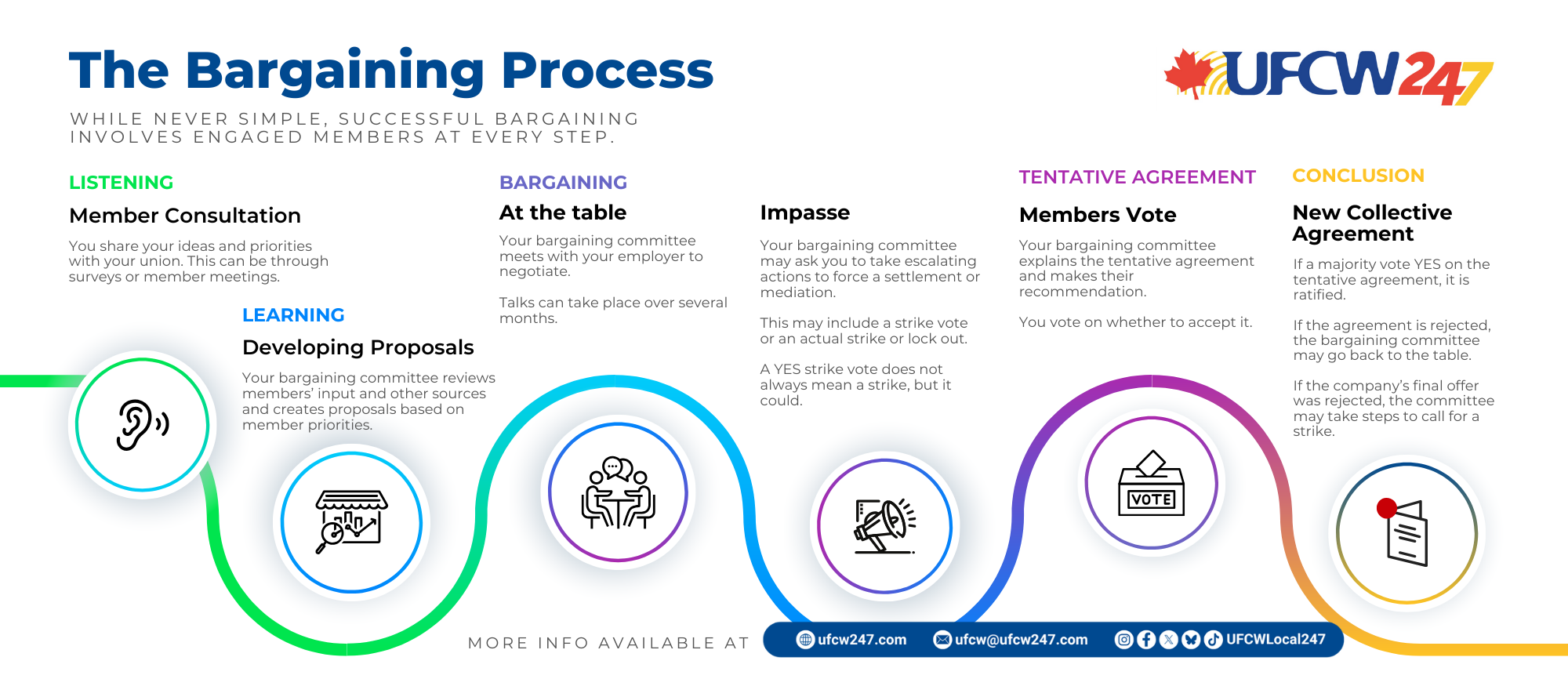
It depends on the context. Sometimes negotiations can be done in just a few meetings. In other cases, when it involves a large number of employees or complex issues, it can take several meetings held over many months.
What are proposals and where do they come from?
Bargaining proposals are the items that each side, the union and the employer, brings to the table to negotiate.
A union’s bargaining proposals are developed by a union bargaining committee made up of members from the workplace and union staff negotiators. These proposals are usually determined after a bargaining proposal meeting or membership survey. These processes help the bargaining committee to determine bargaining priorities, so that the outcome most closely reflects the preferences of the membership.
An employer also comes to the bargaining table with bargaining proposals and priorities. In some cases, they could bring, for instance, a proposal that seeks to take away certain things employees enjoy under the current contract. We call this a “concession.”
Who is on the union bargaining committee?
The union bargaining committee is comprised of union members selected from the workplace – either by appointment or through elections – alongside union staff negotiators, union representatives, and in certain instances union legal counsel. The union bargaining committee has the authority to negotiate on behalf of the membership and reach a tentative agreement with the employer.
A tentative agreement reached by the bargaining committee doesn’t come into effect until the members have voted to accept or reject it. This is called a “ratification vote.”
Most committees, having participated in the bargaining discussions the whole way along, make a recommendation either for or against accepting a tentative agreement.
What happens at the bargaining table?
Under the law, both the union and the employer have a duty to bargaining “in good faith,” meaning both sides should be entering into discussions with the intention of reaching an agreement.
Discussions at the bargaining table are usually quite formal. Each side usually presents its priorities and proposals. Alongside each proposal, lead negotiators make arguments and seek to convince the other side of the merits of their proposals.
Often, bargaining committee members speak to specific issues, sharing their intimate knowledge of the workplace and operations.
In between face-to-face meetings with the employer, committee members caucus and work hard on developing further arguments, looking at other comparable collective agreements elsewhere, and evaluating proposals and arguments coming from the other side.
Who decides if we get something or not?
Both the union and the employer negotiate what they believe their principals can live with. The union’s principals are its members. The employer’s principals might be a CEO or Board of Directors.
That said, nothing is decided until “ratification.”
Different unions operate in different ways. In our union, nothing is decided or finalized until the members have ratified (i.e. voted to accept) a tentative agreement.
If our current agreement expires before we get a new one, what happens?
Even if your agreement has expired before a new one has been reached, it remains in full force and effect until the earlier of either:
- a legal strike by the union; or
- a legal lockout by the employer
Once a new agreement has been reached and ratified, it will come into effect based on what the parties have agreed, which is typically set out in the Tentative Agreement.
How can I find out what happens at bargaining?
Your union bargaining committee members will likely be sharing updates with the membership after each meeting. Members should feel free to ask their bargaining committee members questions about the process and their general take on how things are going.
Often, bargaining updates are posted on bulletin boards in your workplace, and in some instances, they are posted on our website at www.ufcw247.com.
We also usually send out bargaining updates directly to members by email. Be sure to make sure you have provided us with current contact information, including your email address, so you don’t miss out on key updates along the way.
How can I share my feedback during the bargaining process?
Along with providing key information to members during the bargaining process, your union bargaining committee members are available to receive your feedback.
In addition to the initial bargaining survey, it is also possible for members to be invited to participate in further bargaining surveys and polls along the way.
Feedback can be directed to your bargaining committee by calling our Head Office at 1-888-361-8329 and by email via ufcw@ufcw247.com.
What is a strike?
A strike is when union members collectively withdraw their labour – that is, they stop coming to work as a way of pressuring their employer to see bargaining issues their way.
What this usually looks like is union members forming legal picket lines outside their workplaces to draw attention to their job action and engage the public about their issues.
Striking workers usually refuse to come back to work until they receive a contract offer from their employer that they find acceptable.
Strikes are a powerful tool used by unionized workers in contract negotiations. We know that when an employer knows that its workers are prepared to strike to achieve their demands, they are more inclined to negotiate fairly.
The right to strike is protected by labour laws, but to exercise this right legally, there are key requirements under the BC Labour Relations Code.
What is a lockout?
Much like how unions have strikes, employers have lockouts.
A lockout is a legal mechanism available to an employer to stop employees from being able to work, thereby putting pressure on a union and unionized employees to accept its position and settle.
How will I know if there could be a strike or a lockout?
Even when parties have reached impasse, most collective bargaining disputes are resolved without a strike or lockout.
There are usually many steps to take during the bargaining process – from mediation to member mobilizations to strike authorization votes – and if we are headed in the direction of a strike or lockout, it is highly likely that you will have received a lot of information from us in advance.
How can I be best prepared for a possible strike or lockout?
Even when we are several steps away from a possible strike, it’s never too early to start preparing.
UFCW Canada has created Being Prepared, a helpful guide with steps to take well in advance of a possible strike. It includes general information about labour disputes, how to prepare financially (notifying your bank and creditors, for example), and general rules around picketing.
What is a Tentative Agreement?
When your union bargaining committee believes they have reached an agreement that meets the key objectives of the membership, they will enter into a tentative agreement with the employer.
The union will then notify the members that we’re at that stage and will prepare a document to review and share with the membership. This usually takes some time, as it may include a large number of additions, revisions, and deletions. We also like to include explanations for what each clause means.
The tentative agreement is then brought to the members for a vote. This is called a ratification vote.
Why do I have to vote on the contract?
Because the outcome of the vote affects you the most. Your Collective Agreement sets out your terms and conditions of employment, and voting to accept or reject it has real implications for you.
That’s why we vote our contracts – so members decide!
If we reject a Tentative Agreement, what happens?
If it happens that members have voted to reject a tentative agreement, among other possibilities, these are the kinds of things that could happen next:
- We could request further bargaining sessions with the employer;
- We could request further dates with the assistance of a mediator to help the parties through the areas of impasse;
- We could take a strike authorization vote, to increase our union bargaining committee’s leverage in negotiations and/or the employer could threaten to lock us out.
Once a Tentative Agreement is accepted, when does it take effect?
The effective date of a tentative agreement are usually set out in the agreement itself, whether it is the first payroll after ratification or some other date agreed to by the parties.
It should be notes that retroactivity of a change (i.e. whether a change is back-dated to sometime before the new agreement was reached) is something that must be negotiated and agreed to by the parties.
Do you have more questions?
We are constantly refreshing information for members to make sure it is timely and relevant.
Is there a question you or many of your fellow members have that you think should be covered here?
Please don’t hesitate to reach out to us at communications@ufcw247.com.


